
There’s a particular kind of tired that sleep doesn’t fix.
You know the one. You wake up already heavy. You get through the day, but just barely. You smile when you need to, say you’re fine when someone asks, and then sit quietly in your car before you walk into the house — just needing one more minute.
That’s stress and depression. Not always dramatic. Sometimes just this: a weight you carry so long you’ve forgotten what it felt like to put it down.
If that’s where you are right now, this is for you. Not a list of tips. Not a pep talk. Just the truth — from Scripture — about what God says to people who are exactly where you are.
Before we get to the verses, can we just sit here for a second?
Because one of the loneliest parts of stress and depression is the quiet belief that something is wrong with you specifically. That other people have it together. That people of faith — real faith — shouldn’t feel this way.
That belief is a lie, and the Bible is very clear about that.
David, a man described as someone after God’s own heart, wrote Psalm 42 from the inside of what sounds a lot like depression: “Why, my soul, are you downcast? Why so disturbed within me?” (Psalm 42:11). He wasn’t asking rhetorically. He genuinely didn’t understand why he felt the way he felt — and he was talking to himself about it.
Elijah, one of the greatest prophets in the Old Testament, sat under a tree after one of his greatest victories and asked God to take his life (1 Kings 19:4). Burnt out. Done. He’d had enough.
Jeremiah was called the weeping prophet for a reason.
The point isn’t that their faith failed them. The point is that stress and depression are part of the human experience — and God met every single one of these people exactly where they were, without a lecture.
He’ll meet you there too.

Photo by Mick Haupt on Unsplash
There’s no single verse that makes it all disappear. Anyone who tells you otherwise hasn’t sat long enough with the hard parts of their own life. But Scripture gives us something more durable than quick relief — it gives us an anchor.
Here are the ones that matter most.
“The Lord is close to the brokenhearted and saves those who are crushed in spirit.”
This is probably the most important thing to know when you’re in the middle of it: God doesn’t pull back from pain. He moves toward it.
“Close” is not distant. It’s not watching from far away with sympathy. It’s near. Present. The same God who spoke the universe into existence is described here as leaning in toward the person whose heart is broken.
If you feel far from God right now, it’s worth asking — is it that He moved, or that your pain has made it hard to sense Him? Because Psalm 34 is pretty clear about where He is when you’re crushed.
“Come to me, all you who are weary and burdened, and I will give you rest. Take my yoke upon you and learn from me, for I am gentle and humble in heart, and you will find rest for your souls. For my yoke is easy and my burden is light.”
Jesus said this to people who were exhausted by religion — by the weight of trying to be enough, do enough, measure up enough. Sound familiar?
The invitation here isn’t “get it together and then come.” It’s “come as you are — weary, burdened, running on empty.” The rest He’s offering isn’t just sleep. It’s rest for your soul — which is a different thing entirely, and the thing that stress and depression most deeply rob from you.
“Do not fear, for I am with you; do not be dismayed, for I am your God. I will strengthen you and help you; I will uphold you with my righteous right hand.”
Stress lives in the gap between where you are and where you’re afraid things are heading. It’s the constant low-level alarm that something is about to go wrong — or already has.
God’s answer to that alarm, over and over in Scripture, isn’t “calm down.” It’s “I am with you.” The presence of God doesn’t eliminate the hard thing, but it changes everything about how you face it.
“I will uphold you” — that’s not you holding yourself together. That’s someone holding you.
“Do not be anxious about anything, but in every situation, by prayer and petition, with thanksgiving, present your requests to God. And the peace of God, which transcends all understanding, will guard your hearts and your minds in Christ Jesus.”
This might be the most quoted mental health verse in Christian circles, and also one of the most misread. “Do not be anxious about anything” isn’t a command to feel differently. It’s an invitation to bring everything — everything — to God in prayer.
The result isn’t that the situation changes. It’s that a peace comes that doesn’t make logical sense — that transcends understanding. You can’t think your way to it. You receive it.
That’s different from pretending to be fine. That’s bringing the real weight and finding that God guards your heart on the other side of it.
Looking for words when you can’t find your own? Read: Prayers and Scriptures for Stress and Depression →
“Because of the Lord’s great love we are not consumed, for his compassions never fail. They are new every morning; great is your faithfulness.”
Here’s what makes this one remarkable: it was written by Jeremiah in the middle of one of the most devastating seasons in Israel’s history. He wasn’t writing from the other side of it. He was in it — and he found this truth right there.
New every morning. Not once a week. Not when you’ve earned it. Every morning.
If today was a hard day, there is a morning coming where His compassion is fresh again. That’s not sentimentality. That’s the nature of who God is.
“In the same way, the Spirit helps us in our weakness. We do not know what we ought to pray for, but the Spirit himself intercedes for us through wordless groans.”
Sometimes stress and depression take your words. You want to pray and you don’t know how. You want to reach out to God and all you have is exhaustion.
This verse is for exactly that moment. The Holy Spirit intercedes for you — even when all you can offer is silence, or tears, or just showing up. You don’t have to have the right words. You don’t have to feel anything. The Spirit is already in it.
“Praise be to the God and Father of our Lord Jesus Christ, the Father of compassion and the God of all comfort, who comforts us in all our troubles, so that we can comfort those in any trouble with the comfort we ourselves receive from God.”
This one reframes everything.
The comfort God gives you in your hard season isn’t just for you — it’s meant to flow through you to someone else. Your experience of stress and depression, as painful as it is, becomes a kind of authority. You know what it’s like. You can sit with someone who is where you’ve been in a way that someone who’s never been there can’t.
This is the verse the entire Handcrafted Encouragement brand is built around. God comforts us so that we can comfort others. Not when we’re fully healed. Not when we have it all figured out. Now — right in the middle of your own hard season — you have something real to give.
Reading Scripture about stress and depression is one thing. Letting it actually work on you is another.
Here are a few places to start:
1. Pick one verse and sit with it for a week.
Don’t try to absorb all seven at once. Choose the one that felt most like someone handing you a glass of water — and stay there. Read it in the morning. Write it somewhere you’ll see it. Let it do its work slowly.
2. Say the hard thing out loud to God.
Philippians 4 says to bring everything to God in prayer. Not the cleaned-up version. The real version. The one where you’re not sure you’re okay, and you’re not sure it’s going to get better. God already knows. You’re not protecting Him from anything by softening it.
If stress and depression has taken your words, start here: Prayers and Scriptures for Stress and Depression →
3. Write something to someone who is also struggling.
This might be the most counterintuitive thing on the list — and also the most powerful.
When we’re in the middle of stress and depression, the pull is inward. Close the curtains, go quiet, stop reaching out. And sometimes rest is genuinely needed. But somewhere in that season, there is almost always a name that surfaces — someone who is also quietly carrying something heavy.
Write them a note. It doesn’t have to be long. It doesn’t have to be polished. Just honest. “I’ve been thinking about you. You’re not alone in this.” The act of reaching outward — of using your own pain to fuel someone else’s comfort — is itself a kind of healing that nothing else quite replicates.
That’s what 2 Corinthians 1:4 is describing. And that’s what we built Handcrafted Encouragement around.
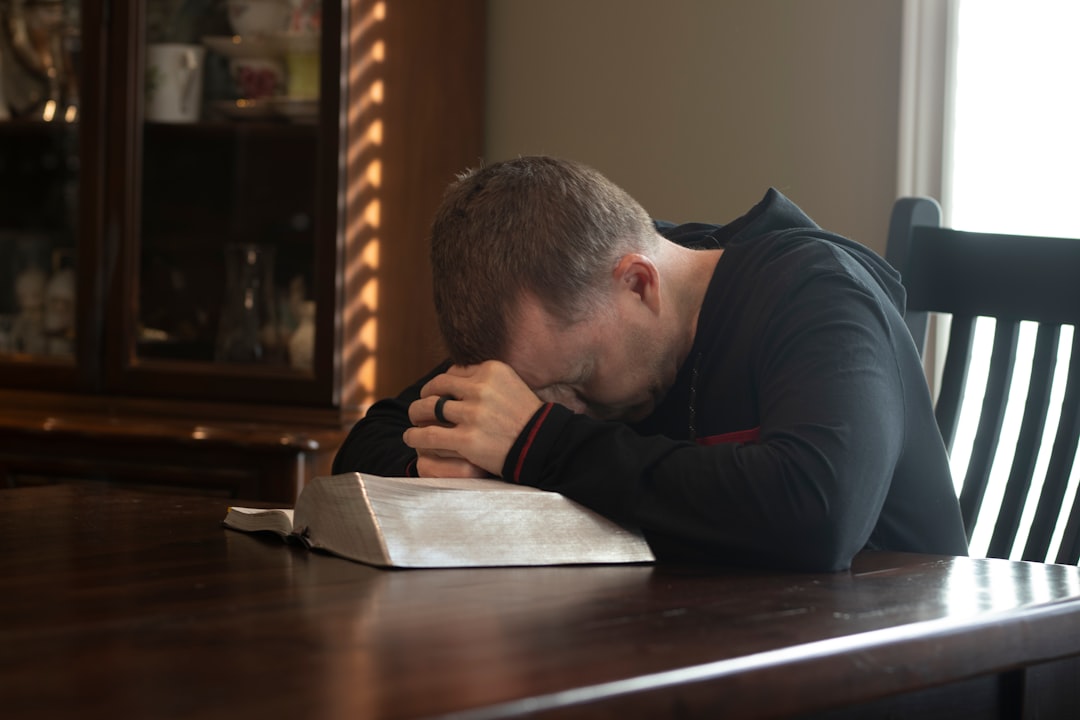
Photo by Malachi Cowie on Unsplash
One of the biggest lies stress and depression tell is that you need to be further along before you can be useful to anyone. Before you can reach out. Before you can be honest with God or with someone else.
You don’t.
The most comforting people in the room are almost always the ones who’ve been in the hardest places — not the ones who’ve never struggled. Your willingness to be honest about where you are is not a weakness. It’s the thing that makes you someone safe to be around.
Not sure what you’re dealing with? Read: Anxiety, Stress, and Depression: What’s the Difference? →
Feeling it in your body too? Read: Symptoms of Stress, Anxiety, and Depression →
Ready for some practical next steps? Read: 7 Faith-Based Ways to Find Relief →
Scripture and faith are not replacements for professional support — and they were never meant to be. If your stress and depression have become unmanageable, please reach out to a counselor, therapist, or your doctor. Seeking help is not a failure of faith. It’s wisdom. God works through people who are trained to help.
If someone in your life is going through a hard season and you don’t know what to say — that’s normal. Words are hard when the weight is real.
That’s exactly why we created the Handcrafted Encouragement devotional. It’s a 193-page workbook built around Scripture-rooted encouragement, with tear-out pages designed to be filled out and handed directly to someone who needs it. Every reflection you complete becomes a note you can give away.
You don’t have to have the perfect words. You just have to be honest.
Explore the Handcrafted Encouragement devotional → — $14.99, free shipping.