Nobody sits down and decides to stay stuck.
If you’re dealing with stress and depression, you’ve probably already tried some things. Pushed through it. Ignored it. Stayed busy enough that you didn’t have to feel it. Maybe you’ve prayed and wondered why the weight didn’t lift. Maybe you’ve read the verses and felt worse because you still felt the same after.
You’re not doing it wrong. You’re just in it.
Coping with stress and depression — really coping, not just surviving — takes more than willpower and more than a verse-of-the-day. It takes a set of practices, each one small on its own, that together create enough traction to keep moving.
Here are seven faith-based ways to find relief when you’re dealing with stress and depression. Not a cure. Not a formula. Just seven honest, grounded things that actually help.
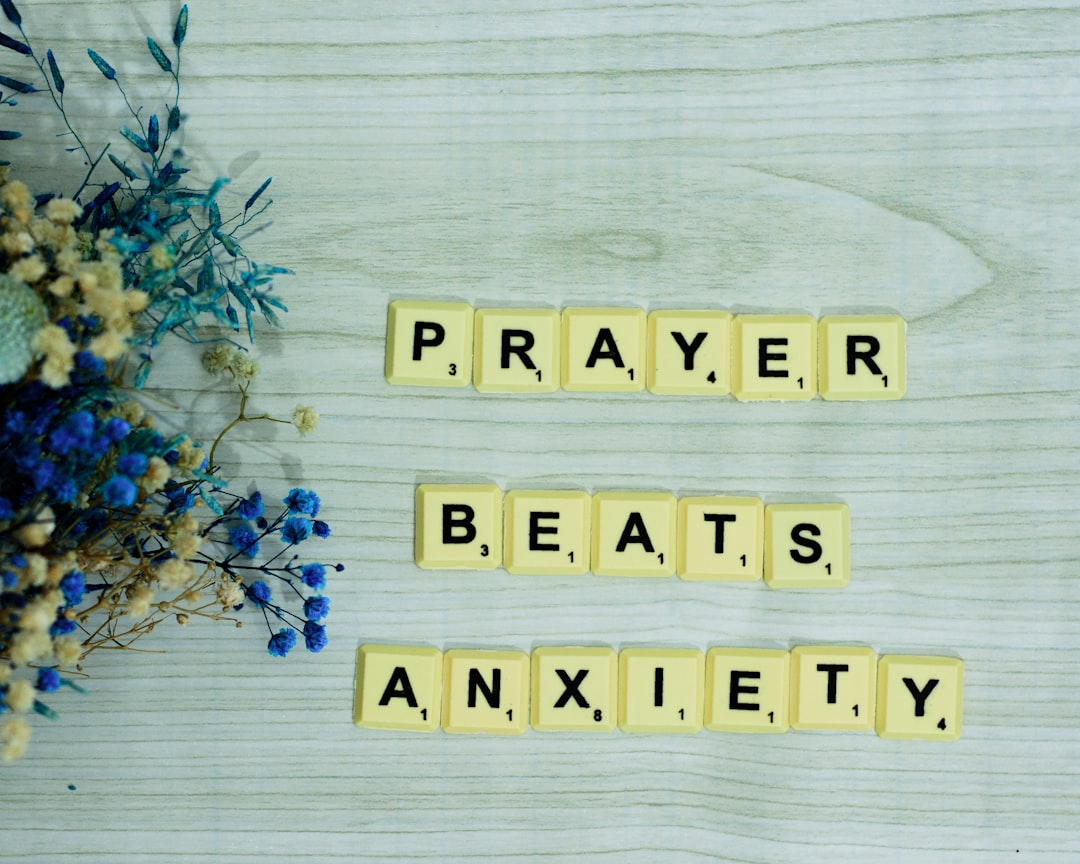
Most of us have two versions of our prayers. The polished one — the one that sounds like faith — and the real one, the one we’re almost embarrassed by.
Start with the real one.
Psalm 22 opens with “My God, my God, why have you forsaken me?” That’s not edited. That’s raw. And it’s Scripture. God isn’t waiting for you to clean up your prayer before He listens. He already knows what you’re carrying. The prayer is for you — to put it into words, to stop holding it inside, to bring it somewhere instead of letting it loop in your head.
You don’t need eloquence. You need honesty.
“Cast all your anxiety on him because he cares for you.” — 1 Peter 5:7
Cast. Not hand gently. Throw the whole thing at Him.
If words have dried up entirely, there are ready-to-use prayers waiting for you in: Prayers and Scriptures for Stress and Depression →

Photo by Markus Winkler on Unsplash
There’s a difference between reading the Bible and sitting with it.
Reading for volume — checking off chapters, moving through a plan — can feel productive while leaving you completely untouched. When you’re dealing with stress and depression, what your soul needs is not more information. It’s contact.
Pick one passage. Sit with it for several days. Read it slowly. Ask what it’s actually saying to you, in your specific situation right now. Write down what surfaces. Let it be a conversation rather than an assignment.
Some places to start:
– Psalm 34 — for when you feel overlooked or crushed
– Psalm 46 — for when everything around you feels unstable
– Isaiah 43 — for when you feel like you’re walking through fire
– Romans 8 — for when you need to be reminded nothing can separate you from God’s love
“Your word is a lamp to my feet and a light to my path.” — Psalm 119:105
A lamp doesn’t illuminate the whole road at once. It gives you enough light for one step. That’s often all we get — and it’s enough.
This isn’t about exercise as a cure for depression. It’s simpler than that.
When stress and depression have you stuck inside your own head, physical movement in an outdoor setting interrupts the loop. It doesn’t fix anything, but it creates a brief window where your senses are engaged with something outside yourself — the temperature of the air, the sound of something other than your own thoughts.
Even ten minutes. Even just walking to the end of the block and back.
Elijah, exhausted and depleted after his encounter on Mount Carmel, was visited by an angel who didn’t give him theology. He gave him food and rest, and told him to get up and walk — because the journey ahead was too much without it (1 Kings 19:5–8).
Sometimes the most spiritual thing you can do is take care of the body God gave you.

Photo by Peter Burdon on Unsplash
Dealing with stress and depression in isolation is one of the most common — and most painful — mistakes people make.
Not because hiding it is shameful. But because depression in particular lies to you about connection. It tells you people don’t want to hear it. That you’ll be a burden. That you should have it figured out by now. Those are lies, and the antidote is exactly what depression tries to prevent: contact with someone who loves you.
You don’t have to tell everyone. You don’t have to post about it. Tell one person the truth about where you are. A friend. A family member. A pastor. A counselor.
“Carry each other’s burdens, and in this way you will fulfill the law of Christ.” — Galatians 6:2
Burdens are meant to be shared. Letting someone carry part of this with you is not weakness — it’s the design.
Not sure how to describe what you’re experiencing? Read: Symptoms of Stress, Anxiety, and Depression: How to Know What You’re Facing →
There’s a particular kind of Christian guilt that comes with rest — the feeling that you should be doing something more productive, more useful, more spiritual. That lying down when things are hard is somehow giving up.
It isn’t.
In the same passage where Elijah sits under a tree and asks to die, God’s response is not a pep talk. It’s not a rebuke. It’s an angel with warm bread and water saying: “Get up and eat, for the journey is too great for you.” (1 Kings 19:7)
God acknowledged that Elijah was depleted and gave him what he needed to recover. Rest was the first intervention. Not a sermon — rest.
If you are running on empty and your body and mind are telling you they need to stop, that is not a lack of faith. That is your nervous system asking for what it needs. Give it to yourself without apology.
“He makes me lie down in green pastures, he leads me beside quiet waters, he refreshes my soul.” — Psalm 23:2–3
Sometimes being led beside quiet waters means actually being quiet for a while.
This one requires a caveat: gratitude is not the same as pretending everything is fine. And it’s not a way to dismiss the hard thing you’re carrying.
It’s a deliberate reorientation. A choosing to hold two things at once: this is genuinely hard, and there is still something here that is good.
When you’re managing stress and depression, your mind naturally narrows — it focuses on what’s wrong, what’s at risk, what hasn’t worked. Gratitude is the practice of widening the lens. Not to erase the hard thing. Just to keep it from filling the entire frame.
It doesn’t have to be big. The coffee was good this morning. That conversation helped. The light came through the window at a good angle. Small and true.
“Give thanks in all circumstances; for this is God’s will for you in Christ Jesus.” — 1 Thessalonians 5:18
In all circumstances — not for all circumstances. There’s a difference. You’re not thanking God for the depression. You’re choosing to find what’s still good while you’re in it.
This one tends to surprise people.
When we’re dealing with stress and depression, the instinct is to pull inward — close the curtains, go quiet, disappear. And sometimes rest genuinely requires some of that. But at some point in the process, reaching outward becomes the thing that actually moves something.
Think of someone in your life who is quietly carrying something hard. There’s almost always someone. A friend who went through a loss. A coworker who hasn’t seemed like themselves. A family member in a difficult season.
Write them a note. Not a long one. Not a polished one. Just honest: I’ve been thinking about you. I don’t want you to feel alone in this.
Here’s why this works — and this is the part that might feel counterintuitive: the act of encouraging someone else interrupts the inward spiral of depression. It pulls your attention, even briefly, toward someone else’s need. And in doing something for them, something in you shifts too.
This is the principle behind 2 Corinthians 1:4 — “He comforts us in all our troubles, so that we can comfort those in any trouble with the comfort we ourselves receive from God.” The comfort you’ve been given is meant to move through you. And when it does, something happens to both the giver and the receiver.
That’s what the Handcrafted Encouragement devotional was built around — Scripture-rooted reflections with tear-out pages you can fill out and hand directly to someone who needs it. Every page you complete becomes a note you can give away. It’s one of the most tangible ways to put this into practice.
See the devotional → — $14.99, free shipping.
Start with one. The one that felt most like someone handing you a glass of water. Do that one today. Not because it will fix everything — but because something small and true done consistently creates more traction than a dramatic effort that exhausts you.
You’re not trying to overcome stress and depression by willpower. You’re creating conditions where healing is possible, and where God has room to work.
That’s enough for today.
Ready to go deeper on prayer and Scripture specifically? Read: Prayers and Scriptures for Stress and Depression →
Want to understand what type of stress you’re dealing with? Start here: Anxiety, Stress, and Depression: What’s the Difference? →
Or go back to the foundation: What the Bible Says About Stress and Depression →