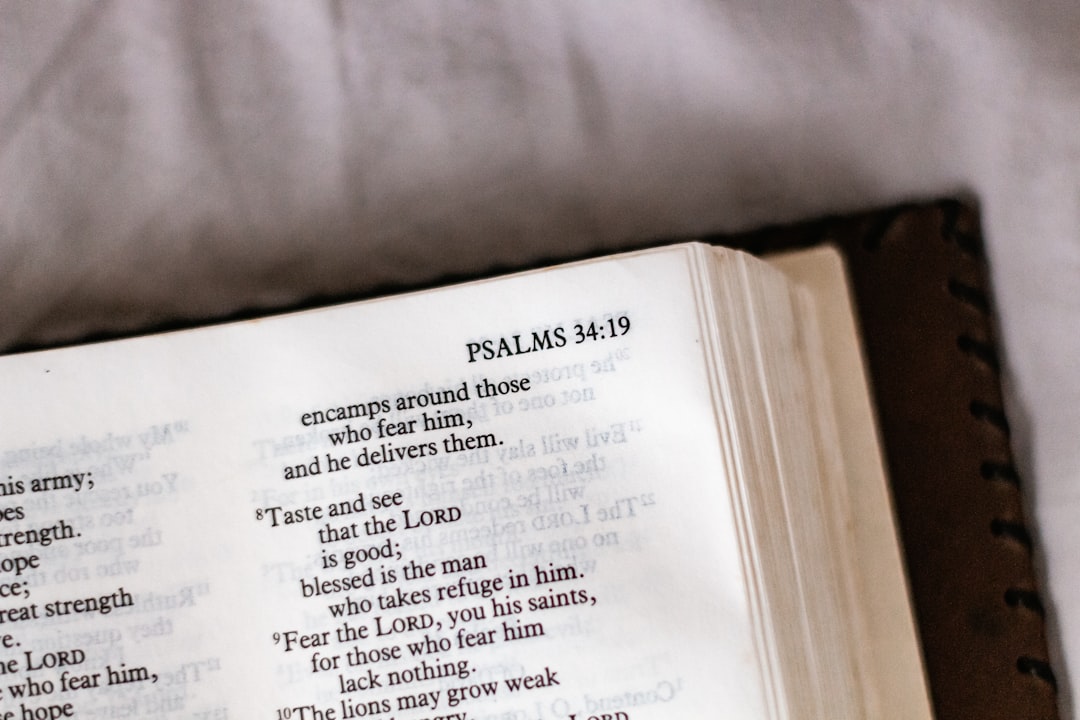
There’s a reason people reach for the Psalms when everything falls apart.
Not the tidy, triumphant parts of Scripture — the Psalms. The ones where David is crying out from a cave, or begging God not to be silent, or asking why the darkness keeps coming. The ones that sound less like church and more like the inside of your own head at 2am.
Healing is not one thing. It’s grief that won’t lift. It’s the anxiety you can’t shake. It’s the exhaustion of being strong for everyone else. It’s fear about the future, loneliness in a room full of people, depression that just… stays. Each of these hurts is real. And the Psalms speak to every single one.
This is not a list of verses to make you feel better fast. It’s a collection of Scripture that sits with you in the hard place — and slowly, gently, points you toward the God who heals.
David was called a man after God’s own heart — not because he had it all together, but because he brought everything to God. The fear, the anger, the despair, the confusion. He didn’t clean it up before he prayed. He prayed it raw.
That’s the gift of the Psalms. They give you language for what you’re carrying when your own words have run out.
“The Lord is close to the brokenhearted and saves those who are crushed in spirit.”
— Psalm 34:18
Whatever kind of hurt you’re carrying today, God is not far from it. He is close to it. And the Psalms have been proving that for three thousand years.
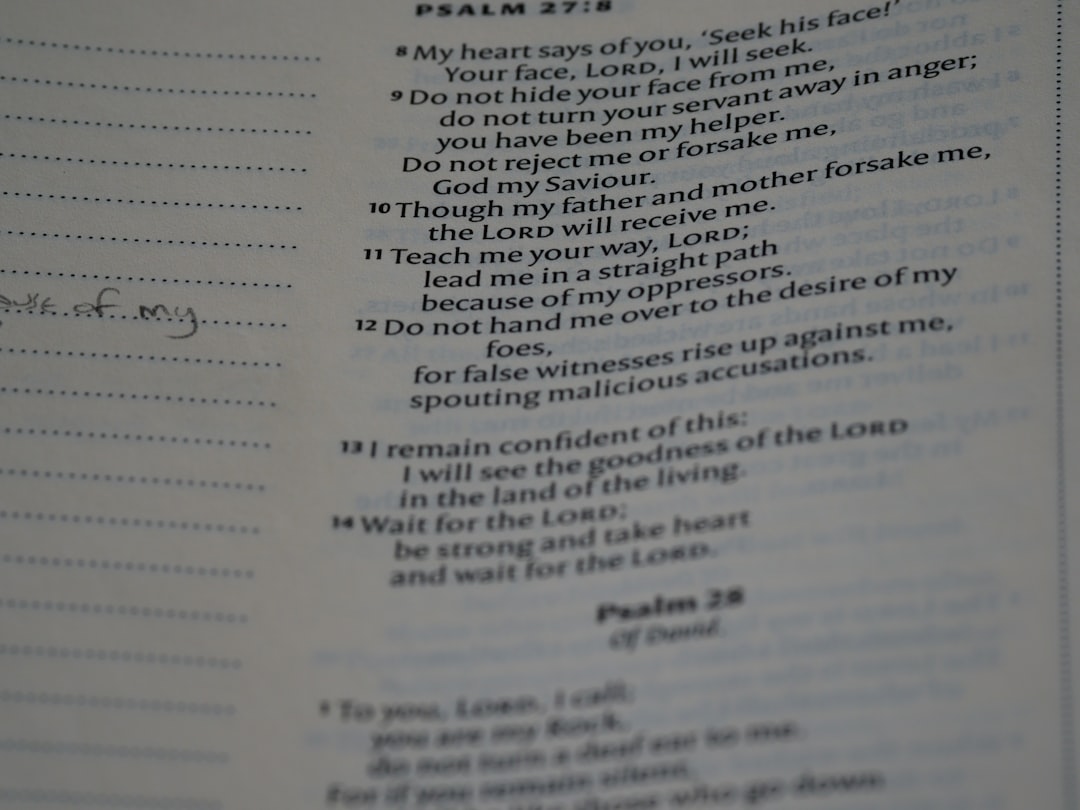
Photo by Brett Jordan on Unsplash
Grief is its own kind of silence. After the funeral, after the calls stop coming, after life moves on for everyone else — you’re still in it.
Psalm 34 doesn’t rush you out of grief. It acknowledges crushed spirits. It promises God’s nearness — not God’s distance, not a timeline for getting better, just presence.
“He heals the brokenhearted and binds up their wounds.”
— Psalm 147:3
That word “binds” is a tender one. Wounds that are bound up haven’t disappeared — they’re being tended. Healing is happening, even when you can’t feel it.
Psalm 23 is often read at funerals, and there’s a reason. “Even though I walk through the darkest valley” — not around it, through it. God doesn’t detour us from grief. He walks through it with us.
→ If you’re in a season of loss, read more in Psalms for Grief.
Anxiety is exhausting in a very specific way — it’s not just that you feel bad, it’s that your mind won’t let you rest. The what-ifs loop. Your body stays braced for something that hasn’t happened yet.
Psalm 46:10 — “Be still, and know that I am God” — is often quoted as a command, but in context it’s closer to a reassurance. You don’t have to hold this together. I am God. I’ve got it.
“Cast your cares on the Lord and he will sustain you; he will never let the righteous be shaken.”
— Psalm 55:22
Casting isn’t a one-time thing. It’s a practice. You cast, and then anxiety picks it back up, and you cast it again. The Psalms are built for that kind of slow, repeated work.
→ For more Psalms to read when worry won’t let go, see Psalms for Anxiety.
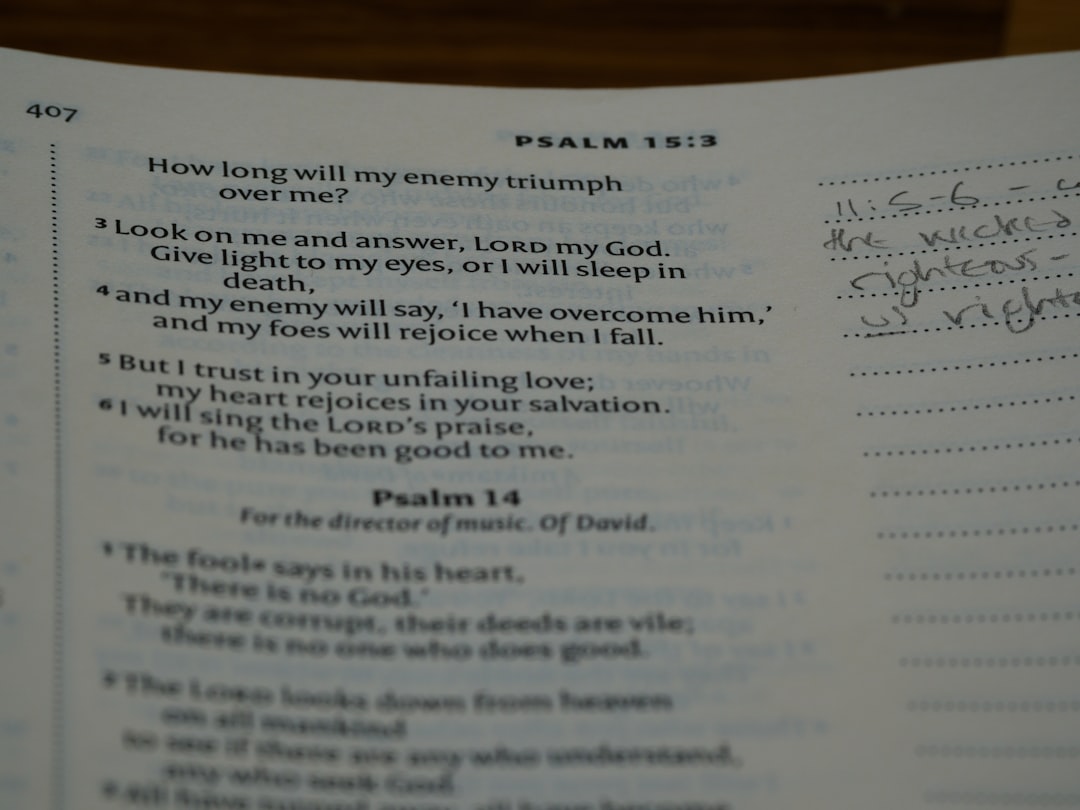
Photo by Brett Jordan on Unsplash
There’s a particular kind of hurt that comes from carrying too much for too long. Caregiving, chronic illness, long seasons of hard circumstances, showing up for everyone else while quietly falling apart.
Psalm 121 is for this.
“My help comes from the Lord, the Maker of heaven and earth. He will not let your foot slip — he who watches over you will not slumber.”
— Psalm 121:2–3
You’ve been trying to stay awake so nothing falls apart. God doesn’t sleep. You can rest.
Psalm 23 returns again here: “He makes me lie down in green pastures, he leads me beside quiet waters, he refreshes my soul.” The refreshing of a soul doesn’t happen on a schedule — it happens when you finally stop pushing and let God lead.
→ When you need God to carry what you can’t, read Psalms for Strength.
Fear wears different faces. Sometimes it’s a specific dread — a diagnosis, a relationship, a financial crisis. Sometimes it’s a low-grade terror you can’t name. Either way, it changes how you move through the world.
“The Lord is my light and my salvation — whom shall I fear? The Lord is the stronghold of my life — of whom shall I be afraid?”
— Psalm 27:1
David wrote Psalm 27 while surrounded by enemies. He wasn’t fear-free — he was fear-grounded. He knew who stood between him and whatever was coming.
Psalm 56:3 is one of the most honest verses in Scripture: “When I am afraid, I put my trust in you.” Not “I am never afraid.” Not “faith means I don’t feel fear.” When I am afraid. As a given. And then: I choose trust anyway.
→ Read more Scripture for fearful moments in Psalms for Fear.
Depression is not a spiritual failure. Some of the most faithful people in Scripture — David, Elijah, Jeremiah — knew what it was to sit in the pit.
Psalm 22 opens with words that echo the darkest moments: “My God, my God, why have you forsaken me?” Jesus quoted these words from the cross. They are not the words of someone who has given up on God. They are the words of someone who is still talking to God when everything feels gone.
“Why, my soul, are you downcast? Why so disturbed within me? Put your hope in God, for I will yet praise him, my Savior and my God.”
— Psalm 42:11
That last line isn’t toxic positivity. It’s a declaration made in the dark — not because everything is fine, but because God has not changed. “I will yet praise him” is a future-tense act of defiance against despair.
→ For more of the Psalms that speak into depression, read Psalms for Depression.
Nighttime has a way of making everything heavier. The house gets quiet and the thoughts get loud. Anxiety that was manageable during the day becomes overwhelming at 2am.
“I lie down and sleep; I wake again, because the Lord sustains me.”
— Psalm 3:5
That line is remarkable in its simplicity. Lying down is an act of trust. Sleep is only possible when you believe someone is keeping watch.
Psalm 4:8 is a bedtime prayer: “In peace I will lie down and sleep, for you alone, Lord, make me dwell in safety.” Not safety because the circumstances are safe — safety because God is present.
→ For a full collection of bedtime Psalms, read Psalms for Sleep.
Loneliness is not just being alone. It’s the feeling of being unseen, unknown, overlooked — in a marriage, in a church, at work, in a house full of people.
David knew this kind of loneliness too. Psalm 25:16 — “Turn to me and be gracious to me, for I am lonely and afflicted.” He named it. He brought it to God without dressing it up.
But then there is Psalm 139 — the great counter to loneliness.
“You have searched me, Lord, and you know me. You know when I sit and when I rise; you perceive my thoughts from afar.”
— Psalm 139:1–2
You are not unknown. You are not unseen. The God of the universe has searched you, and he knows you — every quiet corner.
→ Read more about the Psalms that speak to loneliness in Psalms for Loneliness.
Sometimes you don’t need to identify the specific hurt. You just need something solid to grip.
Psalm 46:1 is that: “God is our refuge and strength, an ever-present help in trouble.” Not a distant help. Not a help that comes when you’ve got your faith figured out. Ever-present. Here. Now.
Psalm 103 is a declaration of everything God is and everything he has done — read it when you need to remember.
“Praise the Lord, my soul, and forget not all his benefits — who forgives all your sins and heals all your diseases, who redeems your life from the pit and crowns you with love and compassion.”
— Psalm 103:2–4
The Psalms for healing are not a formula. They’re a relationship — the kind where you bring exactly what you have, and God meets you there.
→ For Scripture that lifts and encourages, read Psalms for Encouragement. When fear feels like terror, Psalms for Fear has Scripture for that specific feeling. And if someone you love is walking through any of these hard seasons, Psalms for Strength has words you can share with them.
Here’s something the Psalms teach, quietly, over and over: the people who have been comforted become the comforters.
Paul wrote it plainly in 2 Corinthians — God comforts us in all our troubles so that we can comfort others with the comfort we ourselves receive. The healing isn’t just for you. It’s meant to move.
If you’re in a hard season right now, the most counterintuitive thing in the world might be to reach out to someone else who is hurting. But there’s something that happens when you do — the spiral breaks, the focus shifts, and you remember that you’re not alone either.
One of the simplest ways to do that is a handwritten note. Not a text, not a comment — a note. Something physical that someone can hold. If you’re looking for a practical tool to help you do that, our devotional workbook was built for exactly this — 193 pages of faith-based encouragement with perforated tear-out pages you can put directly into someone’s hands. $14.99 with free shipping.
Because healing, when it comes, was always meant to be shared.