
Nobody warns you about the silence.
The week after a loss — there are people around, food on the counter, cards in the mailbox. Then life moves on for everyone else, and you’re still in it. The casseroles stop coming. People stop asking. And you’re sitting in a house that still smells like someone who isn’t there anymore, wondering why it’s not getting any easier.
Grief is not a problem to be solved. It’s a love with nowhere to go.
And if you’ve opened your Bible looking for something that would help and landed in the Psalms — you found the right place. Not because the Psalms fix grief. But because they don’t pretend it isn’t there.
One of the hardest things about grief in Christian circles is the pressure to grieve hopefully. To be sad but not too sad. To miss someone but keep reminding everyone — and yourself — that they’re in a better place.
The Psalms give you permission to grieve loudly.
David didn’t clean up his grief before he prayed. He wept in the Psalms. He complained. He asked God hard questions with no good answers. And God called him a man after his own heart — not despite that rawness, but right alongside it.
You don’t have to perform peace you don’t feel. God already knows what’s in your chest. The Psalms invite you to bring it to him.
Photo by Sincerely Media on Unsplash
“The Lord is close to the brokenhearted and saves those who are crushed in spirit.”
This is one of the most important verses in Scripture for grief, and the word “crushed” is doing real work here. Not disappointed. Not sad. Crushed. The weight of a loss that has pressed everything out of you.
God’s response to that is not distance. It’s closeness. He moves toward the brokenhearted, not away. However quiet things feel right now, this verse insists: he is near.
“He heals the brokenhearted and binds up their wounds.”
The word “binds” is a tender one. Wounds that are bound up aren’t gone yet — they’re being tended. This is not a promise that grief ends on your schedule. It’s a promise that God is actively at work in it, that the wound is not being ignored.
Healing is happening even when you can’t feel it.
“Even though I walk through the darkest valley, I will fear no evil, for you are with me; your rod and your staff, they comfort me.”
Psalm 23 is read at funerals for a reason. But notice the preposition: through. Not around the valley, not lifted above it. Through. God does not detour us from grief. He walks through it with us, step by step, in the dark.
If you’re in the middle of the valley right now, you have not been abandoned there. He is with you in it.
“You keep track of all my sorrows. You have collected all my tears in your bottle. You have recorded each one in your book.”
This verse is almost startling in its intimacy. God keeps track of your sorrows. Your tears are not wasted, not ignored, not rolling unnoticed down your face into nothing. He collects them. He records them.
Every tear you have cried in grief has been seen. Every single one.
“My tears have been my food day and night, while people say to me all day long, ‘Where is your God?'”
The writer of Psalm 42 is describing sustained grief — not an acute moment but a long season of sorrow, complicated by people asking questions that make it worse. Where is your God in this?
If you’ve heard that question, or asked it yourself, this Psalm is for you. The writer doesn’t have a tidy answer. He just keeps bringing his sorrow back to God — and that is enough.
“Be merciful to me, Lord, for I am in distress; my eyes grow weak with sorrow, my soul and body with grief. My life is consumed by anguish and my years by groaning; my strength fails because of my affliction.”
Grief is not only emotional. It lives in the body. The fatigue, the aching, the heaviness that makes everything harder — David describes all of it here. He doesn’t spiritualize it or explain it away. He names it and asks for mercy.
If grief has made you physically exhausted, you’re not weak. You’re human. And God is merciful.
“Weeping may stay for the night, but rejoicing comes in the morning.”
This verse is not a promise that grief will be over by morning. It’s a longer arc than that. But it is a promise that sorrow is not the final word. Joy will come — not as a performance, not as a denial of what you’ve lost, but as a sunrise that eventually breaks over even the longest night.
Hold onto this one for the days when you need a reason to keep going.
Grief can make the ordinary feel impossible. You don’t know how to pray. You can’t find the words. You open your Bible and stare at the page.
Here’s a small thing that can help: copy out one of these Psalms by hand. Don’t think about it too hard — just put pen to paper and write the words. Something happens when your hand moves across a page with Scripture. The body gets involved. The words slow down. You’re not just reading them, you’re carrying them.
And then, when you’re ready — or even before you feel ready — think of someone else who is grieving. A friend who lost someone. A neighbor whose marriage fell apart. A coworker you know is struggling.
Write them a note. It doesn’t have to be long. It doesn’t have to be eloquent. Just tell them you see them, you’re thinking of them, you’re praying for them. Put it in an envelope and send it.
There’s something about reaching toward someone else’s grief — even in the middle of your own — that breaks the spiral. It doesn’t minimize what you’re carrying. It connects you to something larger than it.
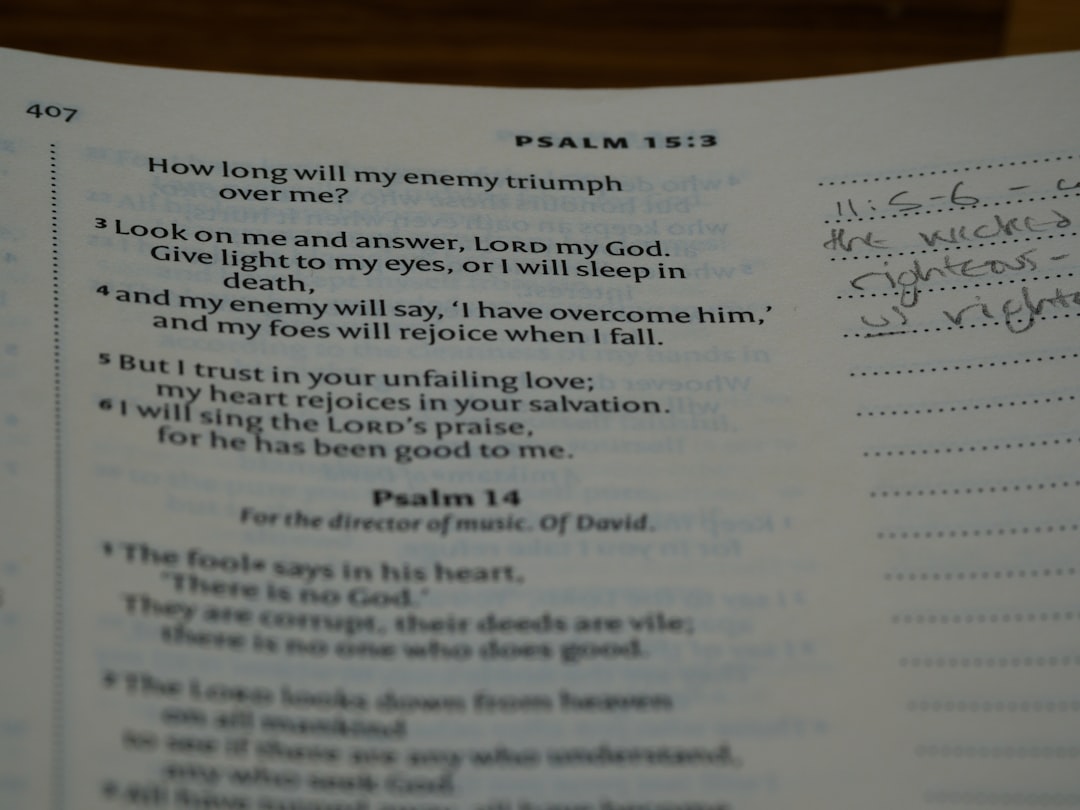
Photo by Brett Jordan on Unsplash
Grief and depression can look alike, and sometimes one slides into the other. If you’ve been in a season of loss and the heaviness isn’t lifting — if you’re struggling to function, struggling to find hope, struggling to see a way forward — please don’t carry that alone. Talk to a pastor, a counselor, or a doctor. There is no spiritual merit in suffering unnecessarily.
And in the meantime, keep coming back to the Psalms. Keep bringing your grief to God, exactly as it is.
If you’re walking through loss alongside someone you love, our devotional workbook was designed for moments like these — something tangible to put in someone’s hands when words feel insufficient. $14.99 with free shipping.